8th Grade Webpage
Internal Architectural Features
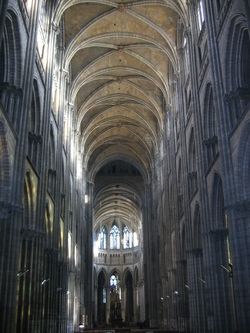
The nave was built in the 12th century and the aisles and vault were built in the 13th century. The nave is similar to Laon Cathedral. It is elevated four stories with restrained height, and it has architectural elements that focus attention downwards instead of upwards like later Gothic architecture.
The choir, built in the 13th century, has 14 pillars, pointed arcades and misericords, which were built in the 15th century. The misericords are carved with depictions of everyday life in the 15th century and various beasts. The chancel was built in the 13th century and is carved with simple lines.
Stained glass representing all of the major art periods from the Middle Ages to early the Renaissance can be found inside the cathedral. The earliest representations are in the ambulatory, with stained glass dating from the early 13th century. The glass resembles that of Chartres, Bourges and Reims.
The Joseph Window is the only stained glass window from its period that is signed by the artist. It is inscribed Clemens vitrearius carnotensis me fecit, or, "Clement, glassworker at Chartres, made me." Another ambulatory window tells the story of St. Julian the Hospitaller, who accidentally killed his parents and spent the rest of his life helping travelers and the sick.
Other interior features include stained glass depicting the Christ's crucifixtion, which was restored after heavy damage during World War II, and stone columns with carved faces at the top. The Escalier de la Librairie, or Booksellers' Stairway, rises from a balcony to the left of the transept. It is decorated with a stained-glass rose window that was made in the 1500's.
The Chapelle de la Vierge, or the Lady Chapel, in the apse contains Renaissance era tombs of the cardinals d'Amboise. The ambulatory and crypt house the tombs of French royalty dating as far back as Duke Rollo, who died in 933 AD. The most famous royal relic is the heart of Richard the Lion-Hearted of England (1157-1199), entombed to the right side of the choir. The rest of his body lies next to his father at Fontevraud Abbey.
Behind the cathedral is the Palais de l'Archeveche, or the Archbishop's Palace, which was bombed during WWII. It was there that Joan of Arc was put on trial in 1431 and posthumously rehabilitated in 1456.
The choir, built in the 13th century, has 14 pillars, pointed arcades and misericords, which were built in the 15th century. The misericords are carved with depictions of everyday life in the 15th century and various beasts. The chancel was built in the 13th century and is carved with simple lines.
Stained glass representing all of the major art periods from the Middle Ages to early the Renaissance can be found inside the cathedral. The earliest representations are in the ambulatory, with stained glass dating from the early 13th century. The glass resembles that of Chartres, Bourges and Reims.
The Joseph Window is the only stained glass window from its period that is signed by the artist. It is inscribed Clemens vitrearius carnotensis me fecit, or, "Clement, glassworker at Chartres, made me." Another ambulatory window tells the story of St. Julian the Hospitaller, who accidentally killed his parents and spent the rest of his life helping travelers and the sick.
Other interior features include stained glass depicting the Christ's crucifixtion, which was restored after heavy damage during World War II, and stone columns with carved faces at the top. The Escalier de la Librairie, or Booksellers' Stairway, rises from a balcony to the left of the transept. It is decorated with a stained-glass rose window that was made in the 1500's.
The Chapelle de la Vierge, or the Lady Chapel, in the apse contains Renaissance era tombs of the cardinals d'Amboise. The ambulatory and crypt house the tombs of French royalty dating as far back as Duke Rollo, who died in 933 AD. The most famous royal relic is the heart of Richard the Lion-Hearted of England (1157-1199), entombed to the right side of the choir. The rest of his body lies next to his father at Fontevraud Abbey.
Behind the cathedral is the Palais de l'Archeveche, or the Archbishop's Palace, which was bombed during WWII. It was there that Joan of Arc was put on trial in 1431 and posthumously rehabilitated in 1456.
